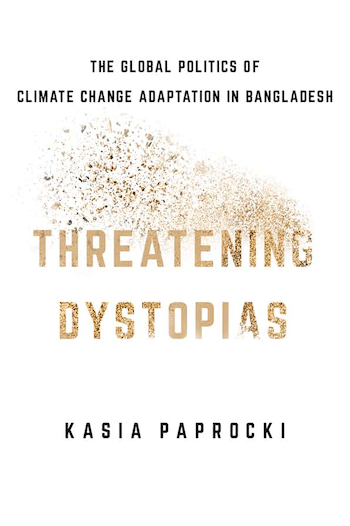
Feb 25. (12pm) Kasia Paprocki (LSE), Threatening Dystopias: The Global Politics of Climate Change Adaptation in Bangladesh (Cornell University Press, 2021) A ground-breaking study of the politics of climate change adaptation, drawing on ethnographic and archival fieldwork, showing how Bangladeshi and global elites ignore the history of landscape transformation and its attendant political conflicts, as development dispossesses the poor from agrarian livelihoods, and outmigration from peasant communities leads to precarious existences in urban centers. (Global Bangladesh) Discussants: Dina Siddiqi, Naveeda Khan, Tariq Omar Ali. In collaboration with South Asia at NYU.
Kasia Paprocki is an Associate Professor in the Department of Geography and Environment at the London School of Economics and Political Science. She holds a PhD in Development Sociology from Cornell University. Her work draws on and contributes to the study of the political economy of development and agrarian change. Threatening Dystopias is based on over two years of ethnographic and archival research in South Asia and Europe, examining the political ecology of climate change adaptation in coastal Bangladesh. She has received fellowships and awards from the National Science Foundation, the Fulbright Program, and the Social Science Research Council.
Dina M. Siddiqi is a Clinical Associate Professor in the Faculty of Global Liberal Studies at New York University. She holds a PhD in Anthropology from the University of Michigan. Her research, grounded in the study of Bangladesh, joins development studies, transnational feminist theory, and the anthropology of Islam and human rights. She has published extensively on the global garment industry, on gender justice and Muslim women, and the cultural politics of nationalism. Her publications are available at ResearchGate.
Naveeda Khan is Associate Professor of Anthropology at Johns Hopkins University, where she also sits on the board of the Center for Islamic Studies. Her research spans riverine lives and national climate policy in Bangladesh, UN led global climate governance processes, and Bengali and Urdu literature and writings on the environment. She is the author of Muslim Becoming: Aspiration and Skepticism in Pakistan (2012) and editor of Beyond Crisis: Reevaluating Pakistan (2010). He book manuscript “River Life and the Upspring of Nature” is in press and “Accounting for an Uncertain Future: the Paris Agreement and the Global South” in under review. She is also working on two manuscripts “Householding on a Warming Earth” and “Schelling and the Global Soil of Thought.”
Tariq Omar Ali is Associate Professor of South Asian History at the School of Foreign Services at Georgetown University. His first book, A Local History of Global Capital: Jute and Peasant Life in the Bengal Delta, (Princeton University Press, 2018), examined how jute cultivation entangled the East Bengal peasantry in global circulations of commodities and capital and, in turn, how these entanglements transformed the material, intellectual, and political life of the jute-cultivating peasantry. He is currently working on a project examining how peasants, river-steamer crews, and small-town capitalists in East Pakistan experienced and participated in the creation of a Pakistani national economy after partition and independence in 1947.
February 25, 2022
Time: 12pm
Organizer: South Asia at NYU
Presenter: Kasia Paprocki
Panelists: Dina Siddiqi, Naveeda Khan, Tariq Omar Ali