20 Sept. Phillip Bowring (Journalist), and Zoe Griffiths (Baruch CUNY)
4:00 – 5:15 Philip Bowring, “Austronesian Asia.” Link to Reading (1)
Phillip Bowring is a journalist based in Asia since 1973 and previously in Sydney, Africa, and London. He has variously been correspondent for the Financial Times, Editor of the Far Eastern Economic Review, a columnist for the International Herald Tribune, and independent columnist and consultant on regional political and economic issues. He has an MA in History from Cambridge University where he is a Fellow Commoner of St Catharine’s College. He is married to Hong Kong legislator Claudia Mo. His recreation is competitive sailing.
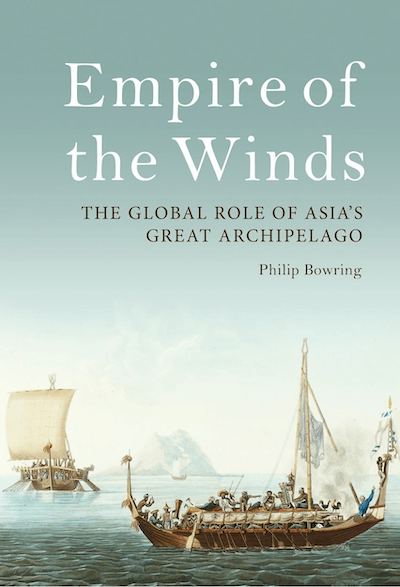
Abstract: This is a region which needs to be recognized in its own right, not as a sub-set of the recently created concept “South East Asia”. In his book Empire of the Winds: The Global Role of Asia’s Great Archipelago, Philip Bowring shows the evolution of this linguistic and cultural entity from its emergence following the last Ice Age, through its role as sailing and trading link from east to west, its divisions by colonialism and imported religions, to today, when it encompasses some 450 million people. Particularly at this time of focus on China’s “historic” claims, the actual history of this maritime region, particularly the pre-colonial eras, needs to be far better known by policy-makers, academics, and journalists. In this presentation, Bowring will define the main themes of this history and its lessons for today.
5:30 – 6:45 Zoe Griffiths, “Modern Losers: Why the History of Early Modern Ottoman Port Cities Has Yet to Be Written.” [Link to Reading(1) (2)]
Zoe Griffith is an Assistant Professor of History at Baruch College, CUNY. Her research and teaching are centered on the history of the Middle East and Islamic world, especially the social, economic, and legal history of the early modern Ottoman Empire. She completed her PhD from Brown University in 2017 with a dissertation on the political economy of Egypt’s pre-colonial Mediterranean port cities at the turn of the nineteenth century.
Abstract: Egypt was the most valuable province in the early modern Ottoman Empire, supplying the empire with locally grown rice and sugar, and distributing the totality of the world’s coffee (via Yemen and the Red Sea) until the early eighteenth century. Yet Egypt’s early modern port cities have received virtually no scholarly attention, coming into focus only with Alexandria’s transformation as a colonial port in the second quarter of the nineteenth century. This disconnect, between Egypt’s cultural and commercial vitality and historians’ lack of interest in its vibrant early modern port cities, is striking but hardly unique. In this presentation, I will discuss some of the epistemological and methodological issues that have caused historians to overlook Ottoman spaces and actors whose primary importance lay beyond their relationship to the rise of industrial capitalism, and how these problems might be addressed in future scholarship. I also argue that Egypt’s Mediterranean ports offer an ideal case study for the political, cultural, and fiscal pressures that would launch the Ottoman Empire along a path of modernizing reforms from the 1780s onwards.
September 20, 2019
Presenter: Phillip Bowring, Zoe Griffiths