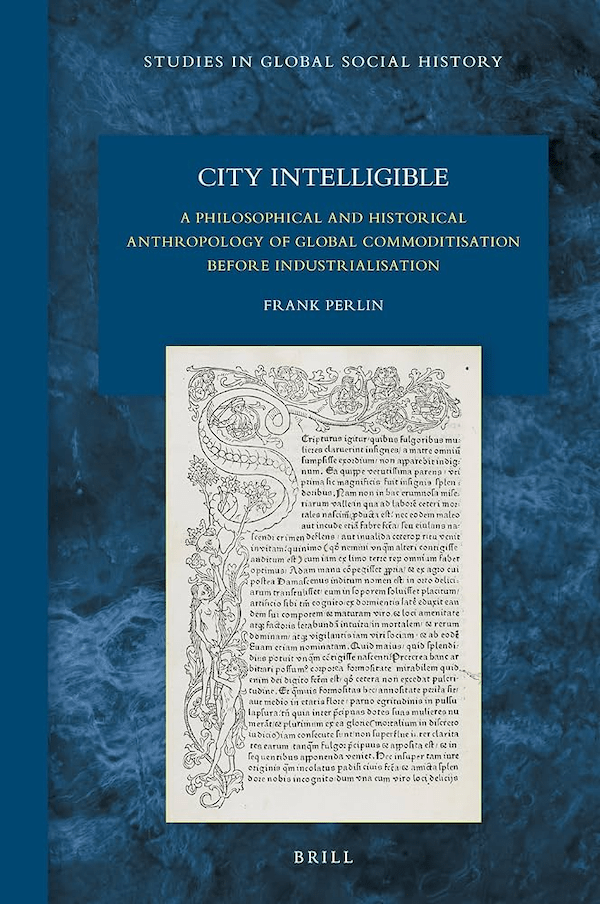
Book Launch/Discussion: Frank Perlin, City Intelligible: A Philosophical and Historical Anthropology of Global Commoditisation before Industrialisation (BRILL, 2020, Studies in Global Social History, Volume: 38)
The book is available online in PDF: here and here, and the Webinar recording is available for viewing online here.
The recording of panel presentations for the January 22 Webinar discussion at the Center for Modern Indian Studies, Gottingen is available at https://www.uni-goettingen.de/en/podcasts+and+webinars/637208.html.
Discussants: Ravi Ahuja (Göttingen), Tania Bhattacharya (Harvard), Anirban Karak (NYU), Andy Liu (Villanova), and Anna Sailer (Göttingen), with introductions by Manu Goswami, David Ludden, and Andrew Sartori (NYU), and response from Frank Perlin.
Frank Perlin is also the author of The invisible city: monetary, administrative, and popular infrastructures in Asia and Europe, 1500-1900 (Aldershot: Variorum, 1993) and Unbroken landscape: commodity, category, sign and identity: their production as myth and knowledge from 1500 (Aldershot : Variorum, 1994)
City Intelligible seeks to integrate a transcendental philosophical anthropology of commoditisation before industrialisation with a social and cultural, thus empirical anthropology of commodity production and exchange that is global, thus inter-cultural. It treats commodification as a singular and privileged evidence of the universal status of human reasoning, and one that grounds the translational character of human exchange throughout the early centuries, and yet that simultaneously founds ubiquitous cultural differentiation. The book constitutes, therefore, a refutation of the predominant tendency in the humanities to represent cultural difference as inhibiting the very possibility of effective intercultural translation.
Discussants and Discussion
Manu Goswami, David Ludden, and Andrew Sartori teach in the History Department at New York University and share research and teaching interests in the histories of South Asia, Economic Thought, Empire, and Capitalism.
Ravi Ahuja is head of the research group ‘Modern Indian History’ at the Centre for Modern Indian Studies of Georg-August-University Göttingen. He has worked on various aspects of India’s social history from 18th to 20th century including urban history, the history of infrastructure and the social history of war. His research interests have increasingly moved towards contemporary history. Current research projects examine the social history of South Asian seafarers and the emergence of a labour-centred social policy in mid-twentieth century India. After teaching at the South Asia Institute in Heidelberg and conducting research at the Centre for Modern Oriental Studies in Berlin he was appointed Professor of Modern South Asian History at the School of Oriental and African Studies (SOAS) in London. He joined CeMIS as its founding director in 2009.
Tania Bhattacharyya is a historian of South Asia and the Indian Ocean. Her book project, Ocean Bombay: Space, Itinerancy and Community in a Port City is a study of transoceanic itinerants in Bombay in the nineteenth and early twentieth centuries, and the production of urban space, communities, and national borders. She is a Junior Fellow at the Harvard Society of Fellows.
Anirban Karak studied economics at Jadavpur University and the University of Massachusetts, Amherst before entering the PhD program in history at New York University. For his dissertation, he is exploring the interconnected histories of capitalism, caste, slavery, and devotional poetry in Bengal between the mid-sixteenth and mid-nineteenth centuries. His overarching research interest lies in bridging the gap between traditional histories of capitalism as the history of European ascendancy, and specifically South Asian Histories. Anirban has published essays on the history of the English Premier League in the Review of Radical Political Economics, on the relationship between Indian Political Economy and state planning in Modern Asian Studies, and on the implications of revisionist Hegel scholarship for historiography in Mediations. He also has an article forthcoming in Critical Historical Studies on the possibility of a dialogue between heterodox economics and the new histories of capitalism.
Andrew Liu is an assistant professor of history at Villanova University. His book, Tea War: A history of capitalism in China and India, was published in 2020 (Yale University Press). He researches and teaches modern China, global history, and political economy.
Anna Sailer teaches Modern Indian History at the Centre for Modern Indian Studies, Georg-August-University Göttingen. She finished her PhD from there, working on the changing organisation of work in the jute industry of colonial Bengal. Her book on the subject is going to be published by Bloomsbury. Her research interests include labour history, social history, and environmental history.
Here is a link to a GoogleDoc open for discussion.