This will be our first in-person (and Hybrid) meeting since March 2020.
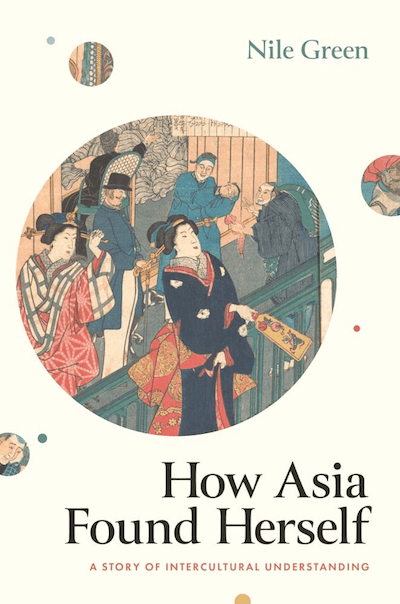
Dec 9. 4-7pm. Nile Green, How Asia Found Herself: A Story of Intercultural Understanding, Yale University Press, 2022. [Hybrid Zoom-In-person in King Juan Carlos I of Spain Center (KJCC 53 Wash Sq South) auditorium] A pioneering history of inter-Asian understanding that shows the cultural constraints on the call for Asian unity. In the nineteenth century, Europe’s empires built vast Asian transport networks to maximize the profits of trade, while Christian missionaries spread printing to bring Bibles to the colonized. The unintended consequence was an Asian communications revolution: a new public sphere that stretched from Istanbul to Yokohama. From all corners of the continent, inquisitive individuals tried to study each other’s cultures, turning the infrastructures of empire to their own exploratory ends. Whether in Japanese or Persian, Bengali or Arabic, they wrote travelogues, histories, and phrasebooks to chart the widely different regions that Europe’s geographers labeled “Asia.” But comprehension does not always keep pace with connection. Far from flowing smoothly, inter‑Asian understanding faced obstacles of many kinds, especially on a landmass with so many scripts and languages. Here is the dramatic story of cross-cultural knowledge on the world’s largest continent, showing the historical constraints on the call for Asian unity.
Full-length Book Talk RECORDING
Nile Green is Professor of History at UCLA, where he holds the Ibn Khaldun Endowed Chair in World History. Green is a historian of the multiple globalizations of Islam and Muslims. After beginning his career as a historian of India and Pakistan, he has traced Muslim networks that connect Afghanistan, Iran, the Indian Ocean, Africa, Japan, Europe and America. A former Guggenheim Fellow, his previous books include Bombay Islam: The Religious Economy of the West Indian Ocean (Cambridge University Press, 2013) (which won the Middle East Studies Association’s Albert Hourani Book Award and the Association for Asian Studies’ Ananda K. Coomaraswamy Book Award); The Love of Strangers: What Six Muslim Students Learned in Jane Austen’s London (Princeton University Press, 2015) (a New York Times editors’ choice); and Global Islam: A Very Short Introduction (Oxford University Press, 2020). He also hosts the podcast Akbar’s Chamber: Experts Talk Islam.
Tansen Sen is Professor of History and the Director of the Center for Global Asia at NYU Shanghai, China, and Associated Professor of History at NYU. He received his MA from Peking University, China, and PhD from the University of Pennsylvania, Philadelphia, USA. He is the author of Buddhism, Diplomacy, and Trade: The Realignment of Sino-Indian Relations, 600–1400 (Rowman & Littlefield Publishers, 2013 , 2016) and India, China, and the World: A Connected History (Rowman & Littlefield Publishers, 2017). He has co-authored (with Victor H. Mair) Traditional China in Asian and World History (Columbia University Press, 2012), edited Buddhism Across Asia: Networks of Material, Cultural and Intellectual Exchange (Cambridge University Press, 2014), and co-edited (with Burkhard Schnepel) Travelling Pasts: The Politics of Cultural Heritage in the Indian Ocean World (BRILL, 2019) and (with Brian Tsui) Beyond Pan-Asianism: Connecting China and India 1840s–1960s (Oxford University Press, 2021). He is currently working on a book entitled The History and Heritage of Zheng He, a monograph on Jawaharlal Nehru and China, and co-editing (with Engseng Ho) the Cambridge History of the Indian Ocean, volume 1.
Zvi Ben-Dor Benite is a Professor of History and Middle Eastern and Islamic Studies at the Faculty of Arts & Science. Zvi has served as Director of the History Department’s MA program in World History, as Acting Director of the Kevorkian Center for Near Eastern Studies, and as Chair of Middle Eastern and Islamic Studies. Specializing in Chinese and Islamic History, Zvi’s research centers on the interaction between religions in world history and cultural exchanges across space and time. He is the author of The Dao of Muhammad: A Cultural History of Muslims in Late Imperial China (Harvard University Press, 2005); The Ten Lost Tribes: A World History (Oxford University Press, 2009); and more recently, an edited volume on Middle Eastern Jewish Thought (Brandeis University Press, 2013); an edited volume on Sovereignty (forthcoming with Columbia University Press); and a monograph entitled Crescent China: Islam and Nation after Empire (forthcoming with Oxford University Press).
Tatiana Linkhoeva is Assistant Professor of History at NYU. Her research and teaching interests center on imperial Japan, collaboration and resistance, and social/ist imaginaries. Her book, Revolution Goes East: Imperial Japan and Soviet Communism (Cornell University Press, 2020), examined the impact of the Russian Revolution of 1917 on the Japanese Left and Japan’s imperial policy. Her second project is a comparative study of Japanese and Soviet empires and their colonial policies on the Mongolian territories. She is the East Asia Editor for the Oxford University Press Online Research Encyclopedia of Asian History.
December 9, 2022
Time: 4-7pm
Presenter: Nile Green
Panelists: Tansen Sen, Zvi Ben-Dor Benite, Tatiana Linkhoeva