
interview with
Dr. Bill Mullen
Afro-Orientalism
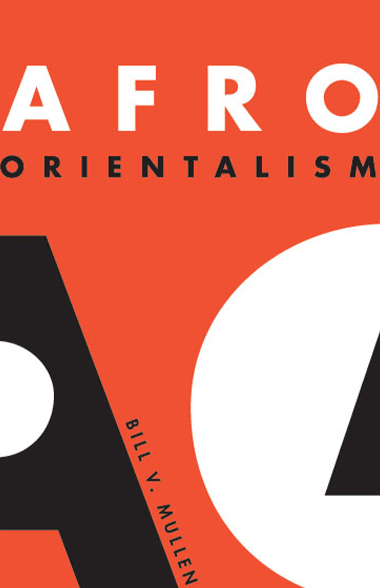
Afro-Orientalism
University of Minnesota Press, 2004.
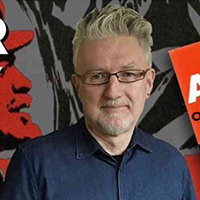
Dr. Bill Mullen
Bill Mullen is a professor of English and American Studies at Purdue University. He specializes in American Literature and Studies, African American Studies, Cultural Studies, Working Class Studies, Critical Race Theory, and Marxist Theory.
When you start looking at the overlap between the slave trade and indentured servants from places like India being sent to East Africa by the British, you realize that that Western history itself has forced African and Asian descended people into what I think of as the same boat.
Afro-Orientalism was the term of pushback. It was a term to say, we recognize each other as each other. We do not subscribe to a white supremacist view of ourselves as subordinate peoples, as slaves, as coolies. So that was its primary meaning.
I was inspired, obviously, by Edward Said's really amazing coinage of the term Orientalism as this Western racist discourse, which really was meant to both stigmatize people of Arab and Asian descent, but also to conquer them. I mean, he says Orientalism is that discourse that goes along with imperialism and rationalizes its processes.
For me, Afro-Orientalism was, in its own way, an inter ethnic anti-imperialism, where blacks and Asians were consciously involved in pushing back against the West. And the other wrinkle in the title was, and I'm a kind of a two-sided thinker, was that it seemed to me there were times when African-American writers would sometimes themselves kind romanticize or exoticize them in world.
I found that really interesting, and I found it to be a political problem, which had to do sometimes with people who live in a place like North America not having sufficient context, understanding, maybe not even being able to read or speak Chinese or other Asian languages, and yet trying to interpret them back to black people here.
I found that from time to time as an important political problem to also think through, because there are internationalism and international solidarity is a hard thing to build and bridge, and there can be gaps, there can be spaces in between where understanding needs to be thought through at a deeper level.
A couple of times in my book, I gestured in that direction, or I thought we don't want to be that kind of orientalist. We don't want to actually re-stigmatize the other. Those were the two ways in which I thought about the title and how I kind of conceptualized it.
It was more than just Afro-Asian solidarity. This was a way that Du Bois felt the whole colonial world could fall apart. It was the first time he was perceiving what became the long story of 20th century rebellions across the Afro-Asian world. The decolonizing movement that happens in Bandung in 1955.
I really spent a lot of time talking about that moment because, I mean it was, it seemed to people who were there, the moment in which consciousness of Afro-Asian solidarity kind of reached a peak. But that was a long process. It took years. It took India's anti-colonial struggle. It took China's liberation struggle. It took, in an interesting way, those struggles becoming sort of the bedrock and inspiration for the African decolonization movement.
It's interesting to me that when you look at Beng Doon you've got Nehru from India, who's just helped to decolonize the country, and he's sitting down with Kwame Nkrumah, who wants to decolonize Ghana. These were very particular conversations that crossed the globe in a very important moment in time. I think I was trying to capture those moments, past and present, and that's one theme.
I think the other thing that really interested me in the book was the way that there's this kind of fluorescent Afro-Asian culture that is always around us and inspiring us. Prashad wrote about kung fu movies in his book and how incredibly important those were to black youth in the 1970s who were looking at Bruce Lee as kind of a stand up guy who would fight against white racism and imperialism during the Vietnam War.
Then I got very involved with working with Fred Ho, the saxophone player and composer, because Fred was really an inspiration for me in a lot of ways. He had dedicated his life and his music to building what he called Afro-Asian music. He had grown up a Chinese-American in the United States, joined the Black Panther party as a Chinese-American when he was a youth, one of the first Asian Americans to do that, and then really began to study what we call the black arts movement in the late 60s and 70s, which really insisted that culture was politics, the art was political.
For Fred as a Chinese American, that sounded different slightly because for him, I think, to be political art would have to include the experience of people like him, right? Chinese Americans. And so he created a band called the Afro Asian Music Ensemble which literally brings together the instrumentation, the harmonics, the melodies, the compositional strategies, of at least two continents. And Fred's work, we can listen to the songs of Japanese women who were sugar cane cutters in Hawaii who would sing what we call work songs. We know them in the African-American context as work songs the slaves would sing while they were working in the Southern plantations. The Japanese-American cane workers were involved in the same kind of cultural making, which was productive and an expression of their exploitation, but in Fred's mind, hearing those work songs in Hawaii was a way of hearing those work songs in the American South.
So that culture, it's important and it's important because it lets people feel the affect of solidarity. It's joyous, it's beautiful, it's alive, and so that was another side of the book for me because most of the people that I wrote about, or many of them, were in fact artists or writers. Richard Wright, W.E.B. Du Bois, who people forget wrote novels and poetry. And in many of those novels and poems... In fact, Du Bois' best novel is this wonderful book called Dark Princess which is this imagined relationship, as you probably know, between a young Black man who's been kicked out of medical school and a South-Asian radical who's just come from Moscow and she's trying to build a revolutionary movement.
And Du Bois, I think, thought the novel and the form of fiction was kind of a utopian form where you could tell the story of Afro-Asian solidarity and its ability to maybe change the world in fiction, even if it hadn't happened in real life. The novel was actually patterned partly after Shakespeare's Midsummer Night's Dream which is a story where humans move into the woods and the world changes. So for me, Afro-Asian culture has been a place of, as I kind of put it a second ago, imagining worlds that might not exist, imagining forms of solidarity that we haven't seen but we need to see, but also realizing the power of art to actually cross cultures, to extend reach. That interested me in the book, as well.
And I feel like that's, for me, the home that I like to situate my own work in and sort of pay tribute to, but I also think there's ongoing... Go back to your point about the attacks on Asian Americans at the beginning of COVID. This is not a done story, right?
We see all the time and even in contemporary culture, how people of color can be pitted against each other. I was thinking about Harvard, the Asian Americans who brought that lawsuit, claiming that too few Asian Americans were getting into Harvard. And I'm like, "Wow, what a way to think about affirmative action," which has been such a critical tool for African Americans going back 50 years now. When those sorts of things start to happen we need to unpack them and say, "Well, wait. What's the history here that we should be thinking about if we want Black folks and Asian folks to kind of rise together?" And it's hard because we live in a capitalist society that values competition and tends to demand that one group wins and one group loses. So for me, Afro-Asian solidarity is all mixed up with that political question as well.
So that's one way in which I think Marxism made Afro-Asia, but it's also interesting the way Afro-Asia remade Marxism, and one of the interesting examples that I talked about in the book is Maoism. And Maoism is an original current of Marxist thinking, identified mostly with Mao Tse Tung, that emerges in 1949 with the Chinese Revolution. And it posits things. First of all, Mao makes a very specific point himself in the early 1960s. He writes a statement in 1963 saying the Chinese Revolution stands with the Negro people of the United States. When he writes that statement, African Americans who are interested in Maoism begin to find it resonates with them in ways that what we might call Marxism before, did not.
And one of the arguments that Mao made was that China was a peasant-based society, the vast majority of people were at the bottom. They were very poor, and that idea of the bottom of the society being the source of the revolution made sense to a group like the Black Panther party, because they were looking around Oakland and they were saying, "Well, wait. We've got all these young Black people, Black men, jobless, homeless, incarcerated." They were what Marx calls the lumpenproletariat.
And this Maoist notion of a revolution led by the most oppressed and exploited sector of the society began to be for them a way of explaining what was going on around them in the Bay Area. And there's interesting slogans. The Black Panthers actually, they raised money partly by selling
Mao's Little Red Book, which was his little book of slogans. Which they would study and read, they would also sell it to raise funds. But they were trying to make Marxism work for them, and Maoism was the Marxism that seemed to work best for them given what they thought was their own situation. But there's one more thing about Maoism which is interesting.
Maoism and third world Marxism, especially in the 1950s and the '60s argued that the subordinate populations of the world needed to stand together, the notion of a third world solidarity. And that was not an original Marxist concept. I mean Marx and Engels didn't write about the third world, in the 19th century that concept didn't exist. But it seemed to be a new tool that Marxism was providing that helped to explain how somebody who lived in Oakland might have something in common with somebody in Vietnam. And this is where the war in Vietnam is so interesting, right? It's a war against Asian people, but the Black Panther Party and SNCC are two of the first groups to stand up and say, this is our war too because the white man's fight there is the fight here.
You had to kind of go through Maoism and you had to go through... Even people like Frantz Fanon who writes this incredible book called Wretched of the Earth, and Fanon's Marxists too. He is trying to use Marxism and class analysis as a tool to cry out, especially across the African world, to describe what national liberation struggle should look like. So for me the relationship we have for Asian Marxism is very dialectical, it's two-sided, it's very creative. And for me it's really an important part of the story because it's hard to find people, in my experience, who were involved in Afro Asian struggle, who didn't pass through Marxism at some point. Either accept it, reject it, reform it, but it was, to go back to my opening, Marxism for them was kind of like a counter discourse too. It was a counter discourse to Western capitalist history and white supremacy. And so it kind of fit into the toolkit of Afro Asia as a counter discourse. If you were trying to dismantle white supremacy and dismantle capitalism, you probably had to stick Marxism somewhere into your agenda.
The universities divide the world into areas. This started in the 1940s when we had this thing called area study. So you might be a Sovietologists, or an Americanist, or an Africanist, but you didn't cross boundaries. You stayed in your quote unquote "field". Well that's what we call being in a discipline, but that's also a way of disciplining the way we think. It means we actually didn't, for a long time we're not encouraged to break down the boundaries, academic, geographical, political between places and spaces and movements.
And I feel like what's happened in the last 20 years or so in the academy is that a lot more people are interested in it, and it's partly because of things like transnationalism, like border crossing, boundary crossing. I mean, Chicano studies has given us so many tools to say, yeah, we all live on borders. We all live on borders, but these insights have worked against the siloing, the segregation, the kind of apartheiding of not just academic study, but people's lived experiences. And until we can actually constantly look at the world as an interconnected space, and we [inaudible 00:28:51] understand capitalism and modernity as affecting all of the people, not just people in the West.
And part of Afro Asia too is a real struggle to continually emancipate us from Eurocentrism. We can't see Afro Asia if we're just going to see through the lens of Europe. So all of that I think has been challenged and broken down, and it's incredibly exciting. I think one of the frontiers that I think will continue to develop in what we might call Afro Asian studies is Afro Arab, Afro Islamic studies.
I think your point is really interesting because I feel like the anti-racist organizers who jumped into BLM, again, did it with an awareness that there was this new set of attacks on people of Asian descent, and I think it helped motivate and trigger wider forms of solidarity.
One of the things that I've been really interested in in this most recent round of protests with Breonna Taylor and George Floyd, is how wildly multi-racial it seems to be. How much cross ethnic solidarity. You've got Latinos in the streets, you've got white people in the streets, you've got Asian people in the streets. That doesn't happen all the time. And I feel like over time when people perceive, when people are thinking really deeply about what I call divide and rule, which is the ways in which a white supremacist society will work to keep people apart from each other, breaking through that moment is, I think, what Afro-Asian solidarity is about, and I think we have seen it in this most recent round of protest.
For me, it's very inspiring because it goes back to some of the things I try to talk about in the book. 100 years ago, when people like Du Bois were trying to say, in a crisis, “Stand up for India,” “Stand up for China.” It's kind of an exciting echo of history.

Cassie Washington
Cassie Washington (Graduate Student in History) is leading our project on Afro-Asian Interactions. She is a fifth-year Ph.D. candidate in our History Department.
Research Interests: Pre-1945 anti-fascist campaigns in British West Africa, Interwar West African Intellectual History, Black Internationalisms, Italian colonialism in East Africa, Decolonizing Fascist Studies.