
interview with
Dr. Marc Gallicchio
The author of The African American Encounter with Japan and China: Black Internationalism in Asia
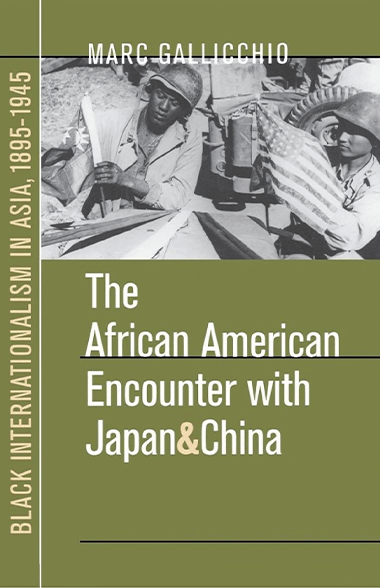
The African American Encounter with Japan and China: Black Internationalism in Asia
Chapel Hill, NC: University of North Carolina Press, 2000.

Dr. Marc Gallicchio
Marc Gallicchio, PhD, is a Professor and Chair of History at the Villanova University. He is an expert on World War II, U.S. foreign relations, East Asia, modern military history and modern U.S. history.
And in that file was an article from the Pittsburgh Courier, complaining about Nationalist China's refusal to admit black GIs into China, the very same GIs who had become known as the Stillwell Road. And, I had been aware of that as it turns out. It was not a revelation, but what caught my eye was the language that the editorial used, and that was to call the Nationalist China out as having betrayed its responsibility as a leader of non-white peoples, and as an opponent of white supremacy.
And I was surprised by that. I was surprised that African-Americans had viewed China in that way. And so that got me thinking, "What is the origin of this?" And then I did know, because again, it's one of these things that people had written about Roy Ottley in particular, that there was African-American in the United States, enthusiasm for Japan. And other historians had briefly mentioned that.
So I said, "Wait a minute, how did we get from Japan to China? What is the origin of all of this, and this language, the rhetoric of liberation and solidarity that was being used?" And at the same time, I was teaching a World History class. And one of my colleagues, Maghan Keita, does African History, and he does it in a global perspective, and some of the sources he used in there, Senghor for example, and others, they use that same language.
And then I also taught with Lawrence Little who had written his dissertation on the AME Church and American Imperialism, which was published a couple of years later. So, that gave me this awareness that there was at least as far as the AME Church was concerned, interest in international affairs, broadly defined, particularly Imperialism.
And then, at the same time, in my field, US Foreign Relations, there was a growing interest. It had always been there, but I think it was more evident by the early 1990s, in non-governmental groups. Emily Rosenberg, wrote this essay, Walking the Borders of the International System. And it was the idea of those people who were on those borders, or moved across them, now they refer to transnationalism as describing that phenomenon.
And I said, "Oh, well, maybe the story I'm interested in is an example of that." And I was then... So I started what turned out to be the end almost, which brought me back... I'm thinking, "Well, where does this begin?" And I thought, "Well, the late 19th century Imperialism seems like a good place to start." American Imperialism.
So that's a long-winded answer, but I hope it might be useful to graduate students, or undergraduates in seeing the ways in which both the investigation of sources, collaboration with other people, the professional trends, all of these things, come together, I think, to shape somebody's research project. At least it did in my case.
And I thought, well neither of these internationalisms really had much to say about African-Americans, nor did the sort of socialism that we would think of seem particularly attentive. Just instead of kind of, everybody's a member of the proletariat, and that didn't seem to adequately characterize the African-American experience.
I thought Black Internationalism is a useful description because it emphasizes the idea of color as being the source of solidarity in international relations. Not because it was exclusively black, or African diaspora, but that it was more broad than that it was internationalist, but that “color” was sort of the key.
And that was pretty expansive, it seemed to me definition, that took into account that could exist comfortably with a kind of Marxist interpretation up to a point, because so much of the colonial world was nonwhite. And so there was a lot of overlap. And so it turned out to be a useful terming, except of course, until Japan invades China. And then that sort of raises the question of how do you characterize Japan, what is China's role and so on? And it put people in an awkward position.
So that's how I kind of settled on that term. And one of the things that I have to say, I came at this from a fairly narrow viewpoint of somebody who's interested in American foreign relations, and I wanted to sort of see how different African-American groups tried to create their own foreign policy in a way that would kind of seek international redress for the problem of racism at home.
Italians had connections to Italy, and of course that becomes apparent in the Ethiopian invasion, and so on. This was different because it went beyond Africa. Black Internationalism Embraced people in Asia, in the colonial world, in the Middle East, so it wasn't the traditional kind of ethnic internationalism that I think American historians were used to writing about. And so that's another aspect of that that interested me as in internationalism, and trying to sort of make it work.
The extent to which anti-colonial resistance leaders all over East Asia and in the Middle East kind of looked to Japan after the Russo-Japanese, and African-Americans were part of that group. Here was an example of a nation that wasn't coded as white, European power having modernized in half a century, and it was a model, it appeared to be then therefore, a model, I mean, Turkey, Ethiopia, they were sort of interested in that; and so were African-Americans.
And so you have both Booker T. Washington and W. E. B. Du Bois didn't agree on a lot, but they both agreed that Japan seemed to exemplify the kind of development they wanted to see. And as Dubois said too, to break the myth of the word white in particular.
And, and I think that identification only grew stronger when it was learned that the Japanese effort to get a racial equality clause in the League of Nations was rejected by Wilson. And then the Japanese exclusion in the 1924 immigration bill, these become sort of key moments in the African-American narrative or history of the coming of World War II.
For them these are kind of milestones on the way, the rejection of Japan as an equal nation, and so on and so forth. I don't think that was a completely accurate picture because there is, during the 1920s, even despite the racial equality clause, there was cooperation between the great powers, which included Japan, for example, and China.
But that is this kind of story that Du Bois will tell and others, and it has a lesson after Pearl Harbor, that is that racism is dangerous for national security.
So why China? Well, after Pearl Harbor, it became kind of difficult to idolize Japan. Although I will say, writers George Schuyler and others, they clearly enjoyed taunting white Americans about, "Well, you discounted these people, and oh well, look what happened." So they weren't entirely silent about that issue, but it was clear that openly supporting Japan would put somebody's freedom, and such as it was, at risk, you'd wind up in jail.
I think you see a revival of the interest in China among African-American internationalists in the 1950s with the rise of Mao, Mao's People's Republic. And that the difference is that it's now, I think, those people who would be more likely to identify as kind of socialist or Marxist, who are supportive of Mao, whereas Gerald Horne calls them the pro-India group. In the NAACP, for them, they're less internationalist in your view and focusing on the fight at home with the resources available at home. So it's a kind of more radical left.
I think the pre World War II and World War II version of that internationalism might've been more pervasive in the African-American community. I mean, I tried to show that it had sort of percolated down to the street level. It was a kind of thing that people talked about, got up on a soap box and gave speeches about and debated in high school and that sort of thing.
But also, the African-American press, which kind of was in its heyday in that period also regularly featured these stories that focused on that connection. And there are books, like the one edited by Rayford Logan, What the Negro Wants and published in the midst of World War II, that sort of has this heavy internationalist focus.
And so I think it had, like I said, it sort of pervaded every level of African-American life. I think after World War II and in the Cold War, in part because of the national security state kind of clamping down on people, descent of any kind, but also a more inward turning of organizations like the NAACP.
Well, you see, then you get sort of like the Black Panther Party, which has an internationalist focus, but that's a relatively small group. I mean, there are clearly sort of militant activists who have an internationalist perspective. I mean, Malcolm X and others, but I don't think there's as many of them.
And so, we're unaware of something that really was there. But my sense is that it is a viewpoint that is shared by a smaller percentage of African-Americans and before World War II, but a group that's extremely energized, militant, and in some respects willing to sort of take more chances, I think.
Even though there's a ban on travel to communist China and these kind of radical... I mean, Dubois of course winds up there, but lots of other people find ways to get there. And that's what I mean by taking more chances. And so it's a smaller group, but it's one that's sort of really animated by a passion for this cause.
... These certain international entities that they can appeal to, or they can hopefully shape, like the UN, but all these sort of collective organizations. But the key is to sort of have that influence on their own national government. And I mean, some people were sort of questioning my conclusion in black internationalism about the success after World War II. I mean, what struck me was that in the end, the Japanese didn't really care very much about African-American liberation, and the Chinese clearly didn't... They were in a dependent position seeking assistance from the American government. They weren't going to do anything to antagonize those Southern congressmen who protected segregation, but also sat on the Armed Services Committee and everything else.
But the other part was even though national leaders, and there were a lot of people around Roosevelt who made this case, that the United States needs to do more for the cause of racial equality, that making that stick at the state level is a federalist kind of problem. I mean, what I saw was here was this moment of maximum danger in World War II, and Roosevelt had to fight like hell to get Congress to let 105 Chinese into the country. I mean, it was really just a gesture. And that to me suggested, and every time you said, "Well, we need to address racial inequality in the United States," the argument was, "Well, not now. We need to be united against the enemy." And I thought that's the kind of argument that got raised in the early Cold War.
This was a preview of the obstacles that black internationalists were going to face. And it's why even though somebody like Dean Acheson, who was in many ways... I mean, even I.F. Stone described him as a liberal, in many respects. He said, "Look, in 1947, we've got to deal with the issue of racial equality within the United States." And 20 years later, the secretary of state, Dean Rusk, is saying the same thing. Everybody sort of knows that's the case, but how... If you say, "Look, the decolonizing world is going to be looking at us. They're making a choice, Soviet Union, China, or the United States. And if they see how we treat non-white peoples, they're going to go in another direction." And then you have somebody like George Wallace who says, "Let them go. And if they don't want our foreign aid, they don't have to take it."
I mean, so to sort of force the states to fall in line is a huge project. And that's why I sort of thought... Which I think is more consistent with the last generation of African-American history is that the success of the Civil Rights Movement is a result of mobilization at the grassroots level. And it's a lot of different movements and a lot of different actions. But it has more to do with what people are doing on the spot than with the international connections that they're making. I use this expression. Harold Isaacs, the sociologist, said, "Well, the one thing that African-Americans know is that as far as the international picture goes, they've got the wind at their back."
I mean, in the sense that you see that colonialism was ending, and that was first time a hopeful sign, but the work still had to be done in the United States. And so that's why I was skeptical about the success of the movement. I thought, as I said, it allowed African-Americans to talk about race at a moment of national crisis and not be thrown in jail as subversive, but rather present themselves as American Patriots in effect. And so it allowed them to keep the issue alive and to organize people and to say, "This is the beginning of a fight, not the end," and so on. So that black internationalism had value, but it was the beginning. It didn't produce the immediate results I think that some people had hoped for.

Cassie Washington
Cassie Washington (Graduate Student in History) is leading our project on Afro-Asian Interactions. She is a fifth-year Ph.D. candidate in our History Department.
Research Interests: Pre-1945 anti-fascist campaigns in British West Africa, Interwar West African Intellectual History, Black Internationalisms, Italian colonialism in East Africa, Decolonizing Fascist Studies.