
interview with
Dr. Robeson Taj Frazier
The author of The East Is Black: Cold War China in the Black Radical Imagination
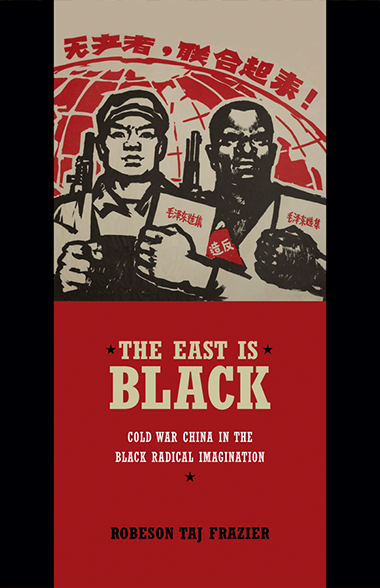
The East Is Black: Cold War China in the Black Radical Imagination.
Durham: Duke University Press Books, 2014.
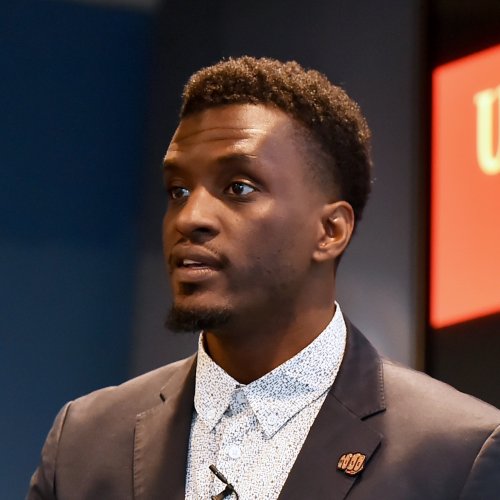
Dr. Robeson Taj Frazier
Robeson Taj Frazier is an associate professor of communication and director of IDEA (the Institute for Diversity and Empowerment at Annenberg). He is the author of two books, a multimedia/film producer, and has published articles and essays about U.S. Black social movements and political ideologies, globalization, fine arts, popular culture, and U.S.-China relations and cultural contact.
What inspired you to write The East Is Black? And what do you think the main arguments of your book suggest about the possibilities and the limitations of sort of Afro-Asian solidarity?
I think one of the main takeaway points of, at least, the project and even my study of that time period was, number one, the challenging circumstances through which... The various people who I was writing about, the challenging circumstances that they all had to navigate. So the challenging circumstances they had to navigate in terms of political repression by the U.S. government and various factions of the state. The challenging circumstances they had to navigate in terms of the representation of radical Black politics in U.S. and European dominant media. And as well as, thinking too about the kind of dominant representations, narratives about China during that time period and people who were interested in obtaining a more nuanced perspective about the developments that were happening in China.
There were some people who weren't even versed in Chinese history and culture, but who were trying to make sense of our country, which had been semi-colonized for some time, was able, in a short time to cultivate among significant portions of the population, a different kind of perception of what was possible. And we were able to develop a commitment to that among different publics in China. So Black folks who were interested in gaining some awareness and insight about that, but also having to navigate all of the political dynamics that were shaping those realities.
So trying to, number one, understand how people on the ground, who in many ways were fleeing political repression, or were trying to escape the, or not even escape, but reshape the possibilities of what people in the U.S. could imagine for themselves. The importance of looking elsewhere, but then also having to navigate the realities on the ground. And then as well, kind of, how did Blackness serve the interests of the Chinese government? How did arguments about U.S. racial dynamics serve the interest of particular segments of the Chinese Communist Party during this same time?
... China and a newly emerging communist government while also highlighting the blatant contradictions and inequities in the US. So it was very much a strategy by the Chinese government to create divisions among the troops. But for a number of the black soldiers, and I'd say working class white, Filipino, Latino soldiers who were in this space, for many of them it was their first time in an educational space where there were some serious conversations about politics and about ideologies, where the veil of US exceptionalism and these narratives about US democracy, where it was kind of removed.
So people who were living in the contradictions of US inequality and democracy in their real lives, who were now fighting abroad, having serious conversations about all of that in a POW camp. So that was the thing I think that Worthy found particularly interesting, that the POW camp... He wasn't trying to say it was just some space where humanity was prioritized. I don't think he was trying to celebrate it, but he was particularly interested in offering a more textured representation of that reality than what was prevalent in US media. And he was particularly interested in, why would these soldiers make the choice at the end, to some degree, of their incarceration to not return to the US but instead to seek out new possibilities in a newly independent communist country?
For him, that highlighted the reality that, for some of these troops, America was not the bastion of freedom and opportunity. It was, in many ways, the sight of terror that they were fleeing from, seeking refuge from. And he was particularly interested in, what did that suggest about the realities of US racism, global capitalism, the increasing disparities in terms of economic elites and the working poor? So I think he was particularly interested in helping to shed some light about that through the voices of black troops.
And censoring that within an explicit critique of capitalism but also an explicit critique of patriarchy and the various ways that masculinist discourses were shaping leftist politics. Numerous black radical men ignored that, whereas Garvin and Du Bois were particularly interested in that. They were particularly interested in highlighting and trying to make sense of the various ways that Maoist ideology was being rethought, reconstituted with an explicit feminist critique among Chinese women.
And thinking about the relationship between that and how black radical women throughout the diaspora utilized black nationalist, black leftist spaces but they didn't prioritize or center their relationship to those spaces within the masculinist ethos, which at times was particularly prevalent in those spaces. Those spaces became fundamental spaces for them to expand and re-shift the conversation to think about the specificity of women's experiences and working class women and poor women's experiences within the global system of capitalism. And so I think that was what was particularly interesting about Garvin's translation of Maoist thought. When she was trying to understand Maoist thought, Maoist ideology, she was particularly interested in trying to increase her awareness of the role that Chinese women had played historically in Chinese political movements, in the transformation of Chinese culture.
But as well as the particular ways, the specificity of how Chinese women had been subjugated within Chinese culture and continue to be subjugated within Chinese culture even under the rule of the Chinese communist party. She was particularly interested in making sense of that but then also using that as a point for potential intersectional connections between black women and Chinese women
And they use music and culture as a tool and resource to, number one, generate cross-cultural awareness about political movements in the US and in China and various parts of the world. So yeah, the kind of connections and direct correspondence is infinite. There's so many, I think, examples to be highlighted, to be further explored and positioned within our understandings of this history of Afro-Asian exchanges and solidarity, most importantly.
I think one of the key jobs, I think, of organizers and especially organizers who are also committed to Afro-Asian building and generating greater Afro-Asian solidarity, and mobilization is, number one, expanding our understanding, our empathy towards one another, expanding our awareness of the vast differences that all of us carry with us, recognizing too, and identifying points to generate greater support, awareness, solidarity, and engagement. So like you said, the kind of anti-Asian treatment and racism that's been heightened over the last couple of months, and also thinking about that in relation to the experiences of repression that African populations in China are currently experiencing.
So, number one, using these as opportunities to become more aware of the various ways that different state institutions and actors are using the pandemic to marginalized, ostracized, particular populations and thinking critically about whose interests that serves, and censoring our critiques of, for instance, police brutality and the glaring gaps, which exist, for instance, in the U.S. in terms of who has access to quality healthcare or who has access to quality air, thinking about that in relation to the various kinds of legal policies that have positioned particular Asian groups in the U.S. with advantages over that of other Asian groups, other Black and Brown populations.
So creating more critical awareness of that, that, we can't just speak about Asians as a monolith. We can't just speak of Black folks as a monolith. But then, as well, working alongside of one another to identify specific actions which demand our immediate attention, while then using the opportunity of us being with each other, to expand our awareness and our understanding towards our differences, towards the different ways we've been positioned historically in the U.S. and elsewhere.
So I think we're living through, obviously, extremely challenging, unnerving times, but it's also, for me, inspiring, because when I look at people who are mobilizing out in the streets, obviously it's, multi-racial, multi-ethnic intergenerational. When I look at the movements who are coming out into the streets throughout the world, it's Black, it's white, it's Asian.
And what I see are people pushing back against the notion of gradual quote unquote change, who are demanding immediate structural transformation and who are studying movements and the political imaginaries of people from different parts of the world, from different areas. So I think it's a particularly interesting moment to think about just the database of movements and history that current-day movements are relying upon in their planning, in their strategizing, and in their efforts to activate people throughout the world.

Cassie Washington
Cassie Washington (Graduate Student in History) is leading our project on Afro-Asian Interactions. She is a fifth-year Ph.D. candidate in our History Department.
Research Interests: Pre-1945 anti-fascist campaigns in British West Africa, Interwar West African Intellectual History, Black Internationalisms, Italian colonialism in East Africa, Decolonizing Fascist Studies.